How to Design Effective Employee Benefits and Rewards: A Complete Guide

- Step 1: Understand what your employees actually need
- Step 2: Set a clear total rewards philosophy
- Step 3: Build your core benefits package
- Step 4: Add rewards and recognition
- Step 5: Measure, communicate, and improve
Most employees don’t leave a job just because of low pay. They leave when they don’t feel appreciated. A fair salary can attract workers, but benefits and rewards are what make them want to stay. When a company takes care of its employees, they are more likely to stay, work hard, and help the company succeed.
In this article, we will explain what employee benefits and rewards are and how to design a program that works for your team.
1.0 What are employee benefits and rewards?
Employee benefits are extra support a company gives its workers in addition to pay. Examples include health insurance, retirement plans, paid time off, and disability coverage. These benefits still have value even if they are not shown in a paycheck.
Employee rewards are given to recognize good work or achievements. They may include bonuses, awards, praise from coworkers, or long-term incentive plans.
Benefits and rewards together are called total rewards. This means everything an employee receives from a job, not only the salary.
And to keep these packages fair and competitive, many organizations today use solutions like Salary.com’s CompAnalyst Software to compare salaries with current market data and guide their pay decisions.
1.1 Why offering competitive employee benefits and rewards matter
Here’s why offering strong employee benefits and rewards is important for your business:
Attract and keep employees: Pay matters, but most people look at the whole package. Health insurance, flexible schedules, and opportunities to learn new skills all show that a company values its employees. In fact, one SHRM survey found that 60% of workers see benefits as a major reason to stay with their employer.
Keep employees motivated and productive: When employees feel supported and valued, they tend to stay focused and work harder. Bonuses, recognition, and small perks can really help motivate people and keep morale high.
Build a good company reputation: Fair pay and good benefits help build a positive reputation. Employees often share their work experiences with friends and contacts. When they feel treated well, it becomes easier for the company to attract new people to join.
Promote fairness and trust: When pay and rewards are clear and fair, employees are more likely to trust the company. This helps prevent confusion, lowers the chance of problems, and makes a more positive workplace.
2.0 How to design effective employee benefits and rewards
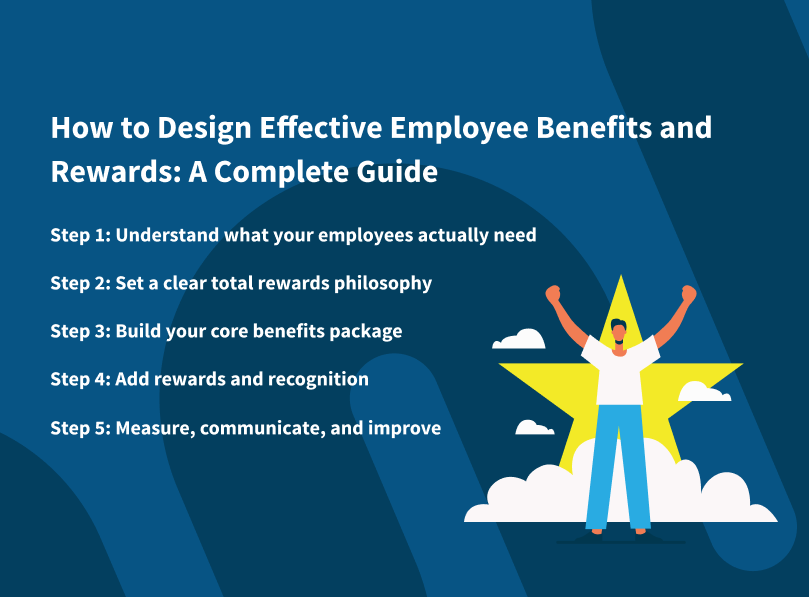
Here’s how your HR can design an effective program for your team:
-
Step 1: Understand what your employees actually need
Before you design anything, listen first. Talk to your employees through surveys, small group discussions, and by looking at your workforce data. Different groups often need different things. Younger staff with student loans may care about other benefits than employees who are supporting families.
Ask simple and direct questions like:
Which benefits do you use the most?
What benefits do you wish we offered?
What would make you more likely to stay?
-
Step 2: Set a clear total rewards philosophy
A total rewards philosophy is a written statement that explains how your organization pays employees, supports them with benefits, and recognizes their work. Without one, pay and benefits decisions tend to be made on the spot and can become inconsistent.
Your philosophy should clearly answer three things:
Do you want to pay below, at, or above the market average?
What matters most to you: salary, benefits, or recognition?
How will you differentiate rewards based on performance?
If you’re not sure where to start, solutions like Salary.com’s CompAnalyst Software can help you see how your pay compares to the market.
-
Step 3: Build your core benefits package
Start with the essentials. This is the foundation of your benefits program. Most companies include health insurance, a retirement plan, paid time off, and disability coverage.
Employees expect these basics, and some may also be required by law. Once these are in place, you can add other benefits on top.
-
Step 4: Add rewards and recognition
Now add programs that motivate and reward employees. Recognition should happen all year, not just at review time.
Start with variable pay. Make your annual bonus plan clear so that everyone knows exactly how to earn rewards:
show the target bonus,
what employees need to achieve, and
how payouts work.
Then, add a recognition program. Let employees publicly recognize each other. These programs are easy to run, cost little, and help boost morale.
For key employees, consider long-term rewards like RSUs or PSUs that vest over time. These reward both good performance and loyalty.
-
Step 5: Measure, communicate, and improve
A benefits program only works if employees understand it. So clear communication matters just as much as the benefits themselves.
Each year, give employees a total compensation statement. This shows the full value of their pay and benefits, not just their salary.
You should also review your benefits once a year. Compare them with what other companies offer. This helps keep your program current as your workforce changes.
3.0 FAQs
Here are frequently asked questions related to the topic:
3.1 What is the difference between benefits and rewards?
Benefits are regular extras employees receive with their pay, such as health insurance, retirement plans, paid time off, and social security. They are provided to support employees and give long-term security.
Rewards, on the other hand, are given to recognize performance or achievements. They are usually short-term and depend on how well someone does. Examples include bonuses, prizes, or public recognition.
3.2 How much should a company spend on employee benefits?
Companies should typically spend 20–50% of an employee's base salary on benefits or aim for a total compensation package of 1.25 to 1.4 times base pay. The exact budget can vary depending on industry standards, company size, and employee needs.
3.3 Are small businesses required to offer health insurance?
No, small businesses with fewer than 50 full-time employees usually do not have to offer health insurance under the Affordable Care Act (ACA). However, if they choose to provide it, they may get tax credits through programs like SHOP marketplace plans or HRAs.
3.4 What benefits do employees value most?
Employees appreciate benefits that help their health and finances. This includes:
health insurance,
mental health support,
retirement plans with employer contributions,
paid time off,
flexible or hybrid work,
bonuses, and
tuition assistance.
These benefits help them feel secure, supported, and financially stable.
3.5 How often should a company review its benefits program?
Companies should review their benefits at least once a year, a few months before renewal. They should also check them every few months, look at trends mid-year, and update them after big changes like new rules or company growth. This helps keep benefits competitive, affordable, compliant, and aligned with what employees need.