How to Use a Compensation Ratio to Reveal Inequity in Your Company

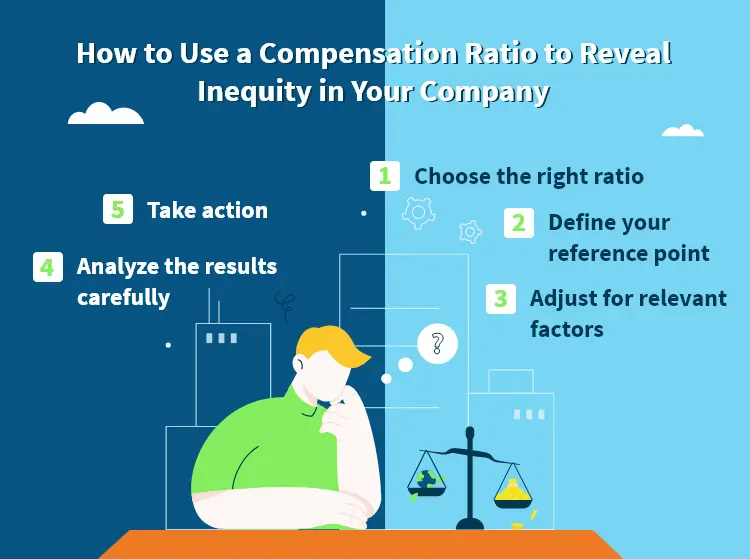
- Step 1. Choose the right ratio.
- Step 2. Define your reference point.
- Step 3. Adjust for relevant factors.
- Step 4. Analyze the results carefully.
- Step 5. Take action.
The compensation ratio is one of the key indicators of fairness in a company. For instance, if two employees, regardless of gender, have similar roles and experience but one is paid more than the other, it indicates a pay disparity that the employer needs to address.
But how exactly do you use a compensation ratio to reveal inequity? This article covers everything, from compa ratio meaning and why identifying inequity in compensation is important to types of compensation ratio and how to calculate one in your organization.
What is compa ratio
A compa ratio, also known as a comparative or compensation ratio, is a measure used to see how an employee's pay stacks up against the market rate for similar jobs. It's calculated by dividing an employee's salary by the midpoint of the salary range for similar positions.
A ratio of 1.0 or 100% means they're paid at the market average, while higher or lower values indicate how much above or below they are. The goal of the compensation ratio is to help companies make informed compensation decisions, ensure fairness, and remain competitive in attracting and retaining top talent.
There are two types of compensation ratios:
Individual compa ratio. This type compares an employee's pay to the midpoint of their position's salary range, showing if they're paid average, above average, or below average for their role.
Group compa ratio. It compares a group of employees' average salary to the midpoint of their salary range or industry median. Group compensation ratio helps evaluate how competitive the company's compensation is for that group.
Challenges and considerations in using compensation ratios
While the compensation ratio is useful for compensation analysis and promoting pay transparency, it's important to be aware of several challenges and considerations when using it.
Reliability of external data
Pay changes based on where, what industry, and what job you're in. Only relying on outside data for compensation ratios might not fit your organization well. Use outside data carefully, thinking about how it fits your specific situation.
Internal job descriptions and classifications
Consistent and accurate job descriptions are important for comparing internal roles with external market data. Inaccurate descriptions can lead to misleading compa ratio calculations. Improve compensation ratio accuracy by ensuring job descriptions are consistent and precise.
Accounting for benefits and perks
Compensations often include bonuses, stock options, and healthcare. Ignoring these extras can affect the result of compa ratio calculations. Consider all forms of compensation, including benefits and perks, for a thorough compensation ratio analysis.
Ignoring individual performance
Compa ratios focus on base salary compared to market rates and may overlook individual performance or merit pay. Ignoring performance can be problematic for high-performing employees. Include individual performance evaluations in compensation decisions for fairness and recognition.
Oversimplifying market dynamics
Market conditions and labor trends change often, making it tricky to compare compensation ratios accurately over time. Failing to adapt can result in compensation strategies that don't fit the market. Make sure to keep track of market changes and update compa ratio benchmarks to match.
Potential for bias
Market data isn't always fair or unbiased. Factors like data availability, sources, and collection methods can make compa ratio calculations result biased. Examine external data sources and use multiple sources to reduce bias in compensation ratio analysis.
Balancing internal equity with external competitiveness
Finding the right balance between fairness within the organization and paying competitively in the market is challenging. It requires careful analysis to align compensation strategies with organizational values.
Communication and transparency
Transparency in compensation practices is important for maintaining employee trust and satisfaction. Explaining compensation ratio calculations and why pay decisions are made can prevent misunderstandings and perception of unfairness.
Ethical considerations
It's important to be fair, equal, and non-discriminatory in compensation. Making sure pay differences are justified and match the organization's values is key to using compa ratios ethically.
Importance of identifying inequity in compensation
Identifying inequity in compensation is important for ensuring fairness and equality in the workplace. It helps to:
Promote equity and justice. By fixing pay inequity, organizations ensure fairness for all employees, regardless of gender, race, or personal traits.
Minimize bias and discrimination. Fixing unfairness in compensation reduces biases, making the workplace fairer and more inclusive.
Safeguard employee dignity and honor. Fair pay practices respect employees' dignity by properly acknowledging and rewarding their contributions.
Improve talent attraction and retention. Companies that value fair pay are better at attracting and keeping top talent because satisfied employees are more motivated when they feel fairly rewarded for their work.
Elevate morale and productivity. Fair pay boosts morale and engagement, which leads to higher productivity and better performance.
Mitigate legal and reputation risks. Fixing pay disparities helps companies avoid legal issues, preserving their reputation and financial health.
Improve financial outcomes. Fair pay benefits companies by improving employee satisfaction, productivity, and retention, which leads to greater success and profitability.
How do you calculate compensation ratio?
Calculating compensation ratio is as easy as ABC. Here's how to do it:
Scenario: Alex (Annual salary: $75,000)
To calculate the compa-ratio for Alex's salary as a junior software developer, we need to compare his salary to the median salary for similar positions within the organization. Let's say the median salary for junior software developer in Alex's organization is $70,000 per year.
The compa-ratio is calculated using the formula:
Compensation ratio = employee's salary/median salary x 100
With the given values, we can conclude:
Compensation ratio = ($75,000/$70,000) x 100
Compensation ratio = 1.07x100
Compensation ratio = 107%
In this scenario, Alex's compensation ratio is 107%, meaning his salary exceeds the median junior software developer salary by 7%. This suggests he's compensated well compared to others in similar roles, possibly above typical norms.
How to use a compensation ratio to reveal inequity
A compensation ratio is useful for identifying pay disparities, but it's only one part of the solution. Here are some steps to effectively use it alongside Salary.com's Compensation Software to ensure fair pay:
Compensation Software is your one-stop tool to ensure pay equity. The tool provides the data and insight you need to ensure you get accurate market midpoints. It also handles the entire compensation process, which enables quick and accurate job pricing and analysis of compensation practices.
-
Step 1: Choose the right ratio
As mentioned above, the compensation ratio compares how much different people in a company are paid. It might compare the highest-paid person's salary to that of the lowest-paid person, or the executives' pay to that of an average employee. The choice of ratio depends on what fairness goals the organization wants to achieve.
-
Step 2: Define your reference point
To use a compensation ratio well, you must set a clear standard to compare pay levels against. This standard could be industry averages, the company's own pay scales, or fairness guidelines. Having this standard helps understand pay ratios better and spot possible unfairness.
Compensation Software includes a Salary Structure that balances internal equity and external competitiveness to provide a strong compensation framework for your business. The tool also has Market Pricing, which simplifies pricing and offers insights using HR-reported pay data, covering every job in every pay market, including those not typically found in surveys.
-
Step 3: Adjust for relevant factors
Considering important factors that affect pay and may lead to perceived unfairness is critical. These factors include experience, education, job duties, performance, and how long someone has been with the company. Considering these ensures fair and precise pay comparisons by acknowledging differences in roles and contributions.
The software has a Job Range Wizard feature that compares internal pay ranges and employee salaries with current market rates. It helps maintain fair pay internally and stay competitive externally. It also suggests ways to adjust, or increase pay across your organization.
-
Step 4: Analyze the results carefully
After calculating the compensation ratios and accounting for important factors, it's important to carefully study the results. Keep an eye out for any patterns or differences that might show unfairness in pay. Watch for any unusual or significant differences from what's expected. If you find any, think about doing more investigation or analysis to understand them better.
The Compensation Software's dashboard is customizable and easy to use. Users can personalize it with different views to focus on specific widgets, making it easier for them to analyze results.
-
Step 5: Take action
If unfairness in pay is found, it's important to do something about it. This might mean changing how salaries are set, updating pay rules, offering more training, or taking other steps to make things fairer for everyone. Taking action shows a commitment to fixing unfairness and making the workplace better for all employees.
The software makes it easy to take action. You can quickly evaluate internal pay differences by employee group and make corrections when necessary. It also allows you to create, modify, and distribute reports on organization-wide pay. Reports can be exported directly for stakeholder presentations.
Using the compensation ratio is essential for revealing inequities in your company, but keep in mind that it's just the tip of the iceberg. Be sure to consider other factors such as experience, education, and job responsibilities to fully address unfairness in pay practices. Also, use Salary.com's Compensation Software to optimize your efforts and enhance your compensation practices.