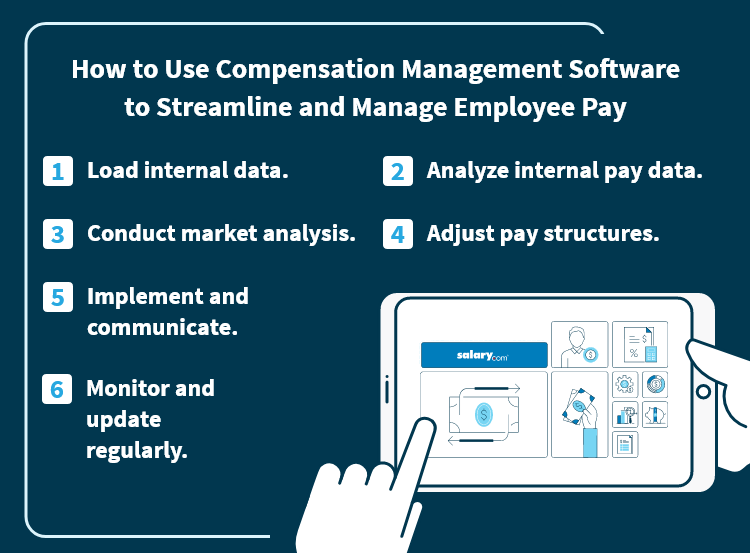
How to Use Compensation Management Software to Streamline and Manage Employee Pay

- Step 1. Load internal data.
- Step 2. Analyze internal pay data.
- Step 3. Conduct market analysis.
- Step 4. Adjust pay structures.
- Step 5. Implement and communicate.
- Step 6. Monitor and update regularly.
Competition among organizations is more intense in today's business world. Organizations now constantly strive to offer the best compensation to attract and retain talent. To effectively manage and streamline employee pay, many organizations turn to various compensation management software. These tools provide a comprehensive solution for analyzing, adjusting, and communicating compensation strategies within a workforce.
Simply using this compensation management software isn’t enough to ensure employee retention and satisfaction. Organizations should understand what exactly it is and the important features to look for when planning to get one. This article covers everything you need to know about comp management software.
What is a compensation management software?
Compensation management software is a tool that helps organizations manage and administer employee compensation and benefits effectively and efficiently. It automates many tasks involved in compensation, including calculating salaries, bonuses, and other forms of compensation, ensuring accuracy and consistency.
The main goal of comp management software is to make it easier for organizations to attract, retain, and motivate employees by streamlining the compensation process.
How can compensation management software help organizations?
A compensation management software offers many benefits for organizations, streamlining processes, improving transparency, and helping make smarter decisions about their workforce. Here are some of them:
Automates manual tasks. The software calculates salaries and incentives, saving time and reducing mistakes.
Reduces errors. The software lowers the risk of mistakes in managing compensation.
Standardizes processes. It ensures that compensation processes are consistent across the organization.
Centralized data storage. All compensation data is stored in one place, making it easier to access and manage.
Data-driven insights. The software analyzes compensation data to provide useful information.
Budgeting and forecasting. It helps plan for future compensation needs based on past data and market trends.
Competitive compensation. The software helps set pay levels that are competitive with industry standards.
Transparency and fairness. It provides visibility into compensation practices to ensure they are fair.
Performance-based rewards. It helps implement pay systems based on employee performance.
Reduced pay inequities. The software identifies and addresses unfair pay practices within the organization.
Do organizations really need a compensation management software?
While not mandatory, comp management software offers significant advantages for most organizations. For larger companies, it streamlines complex processes, ensures fairness and consistency, and provides valuable data for informed decisions. Smaller companies can benefit from task automation, time savings, and improved compliance. However, the costs and implementation effort should be weighed against the benefits and the choice of whether to leverage the software depends on individual needs and resources.
Common myths about compensation management software
Many myths exist about comp management software, which can hinder companies from adopting these tools and benefiting from them. Here are some common myths:
Myth #1: Compensation management software is only for large corporations.
Fact: Comp management software benefits businesses of all sizes by automating salary, bonus, and compensation calculations for accuracy and consistency.
Myth #2: The software is too complex to use.
Fact: Most comp management software is user-friendly with features that simplify administrative tasks.
Myth #3: It’s unnecessary because spreadsheets can do the same job.
Fact: While spreadsheets can be used, software offers more efficient, error-free calculations, data visualization, pay comparisons, and integration with other HR systems.
Myth #4: Compensation management software is too expensive.
Fact: The software's cost should be weighed against the time saved on manual calculations and the potential for increased employee satisfaction and retention.
Myth #5: The software only handles salary calculations.
Fact: Compensation management software handles tasks like tracking performance-based bonuses, managing employee benefits, and generating compensation data reports.
Important features to look for a compensation management software
When searching for comp management software, consider these key features:
Data segmentation
This feature helps organize compensation data by categories like job roles or locations, making it easier to manage and analyze different groups of employees.
Easy access to data
Look for software with a user-friendly interface so you can quickly find and update compensation information without much training.
Automated workflows
This feature automates tasks like salary reviews and approvals, saving time and ensuring consistency in compensation processes.
Reporting and analytics
The software should provide easy-to-understand reports and analytics to help you make informed decisions about compensation.
Security
Choose software that keeps compensation data secure with encryption and access controls, complying with data protection regulations.
User-friendliness
The software should be easy for both administrators and employees to use, with simple interfaces and customizable features.
Customer support
Look for software providers that offer helpful customer support through multiple channels like phone, email, or chat.
Most of the features mentioned are included in Salary.com's Compensation Software. This makes it easier for you to manage your compensation strategy, from organizing data to automating workflows and ensuring security.
How to use compensation management software to streamline and manage employee pay
Now that you know what features to look for in comp management software, it's time to learn how to use it effectively to streamline and manage employee pay in your organization.
Salary.com's Compensation Software provides the data and insights needed for confident pay decisions. It covers the entire compensation process, making it easy to accurately price jobs and analyze pay practices.
-
Step 1: Load internal data
To start, upload your company's data into the compensation management software, including job details, employee information, pay rates, and salary structures. In Compensation Software’s dashboard, hover over "Our Company" and click "File Upload" in the upper right corner. This provides the software with the necessary information to efficiently analyze and manage employee pay.
-
Step 2: Analyze internal pay data
Once you've uploaded the data, use the Compensation Software's Reporting & Analytics feature to run reports. These reports help you analyze employee pay, find discrepancies, calculate the cost of fixing pay gaps, assess employee flight risk, and ensure fair pay across different groups.
-
Step 3: Conduct market analysis
The software lets you compare your employees' pay to market rates, ensuring competitiveness and alignment with industry standards. Use the Employees Pill to compare individual employees' pay, helping you identify those who might be underpaid or overpaid compared to the market.
-
Step 4: Adjust pay structures
Based on the analysis of internal pay data and market benchmarking, you may need to adjust your pay structures. This step involves making changes to your salary structures to ensure that they are fair, competitive, and aligned with your company's goals and budget.
Take note: You should take this step when you observe pay discrepancies or when benchmarking indicates a need for adjustment.
Additionally, the software has a feature that helps users forecast compensation for specific jobs in target markets accurately. It uses pricing intelligence from global market data.
-
Step 5: Implement and communicate
Once you have adjusted your pay structures, you need to implement these changes and communicate them to your employees. It's important to communicate any changes in pay rates or structures clearly and transparently to ensure that employees understand the reasons behind the changes and how they will be affected.
-
Step 6: Monitor and update regularly
Compensation management is a continuous process. Monitor employee pay and market trends regularly, and update pay structures as necessary. This ensures your compensation practices stay competitive, fair, and in line with your company's goals and budget.
Compensation Software gives you accurate market pricing data for over 15,000 job titles in 225 US industries. This data is updated monthly by Certified Compensation Professionals, making it easy to manage your pay structures.
Using spreadsheets and manual processes alone for compensation data can be risky, especially for companies valuing transparency and accuracy. Compensation management software can greatly help. It's important to find software that suits your organization's needs, offering features such as data segmentation, market data comparison, and comprehensive reporting. Salary.com's Compensation Software provides access to these features.